Showing posts with label airplanes. Show all posts

Friday, June 1, 2012

When GIS Fails, Part 2

On February 25, 2009, Turkish Airlines flight 1951 from Istanbul to Amsterdam crashed just short of runway 18R while on final approach.  There were 128 passengers onboard the Boeing 737-800, the world's best selling aircraft.  Nine people died in the crash - including all three pilots and also three Boeing engineers.  Investigators were puzzled - passengers and witnesses said the plane dropped out of the sky.  Why did this happen?

The Boeing 737's fuselage cracked and the engines separated from the wings (Source: flyaway simulation.com)

The cause of the accident was determined to be a faulty radio altimeter on the captain's side of the flight deck (in total, the aircraft has three altimeters).  A radio altimeter is "an instrument that determines elevation, usually from mean sea level, by measuring the amount of time an electromagnetic pulse takes to travel from an aircraft to the ground and back again." [1]  The Boeing 737-800 has four external antennas to assist the altimeter readings - two that send out the signal and two that read the signal back.

At about 8,000 feet above the earth while descending, the captain's altimeter began to show a reading of -8 feet.  The pilots were obviously aware that this altimeter's reading was incorrect and ignored the warning horns that started going off in the cockpit to put down their landing gear.  So if the pilots were aware of the fault, why did they still crash?

There are two automated systems on airplanes that greatly assist pilots - one is the well known autopilot, that controls the yoke, and the other is the lesser known autothrottle, that controls the engines.  The autothrottle's altitude information is supplied by the captain's side altimeter.  Since this reading was showing the plane to already be on the ground, the autothrottle brought the engines power to idle.  Following the instructions of their air traffic controller, the pilots (captain, first officer, and a third pilot assisting the training of the new first officer) were at a stage in their descent where they would have needed the engines to be near idle.  This is not typical of most descents, but it is typical at busy Amsterdam, where ATC tries to bring the airplanes in faster by requiring a quicker/steeper descent.  Because of this unique approach, the pilots did not realize that the autothrottle had actually kept the engines permanently at idle.  With the loss of engine thrust, the airplane kept losing speed and at 460 feet above the ground, it stalled.  The pilots were unable to recover the throttles in time and the Boeing dropped from the sky into a muddy field.


Above is the episode from the show Mayday that discusses Turkish Airlines flight 1951.

Thursday, April 19, 2012

When GIS Fails.

On July 1, 2002, a Bashkirian Airlines Tupolev Tu-154M crashed into a DHL Boeing 757 in mid-air over Germany. The collision killed all 71 passengers onboard both aircraft, including 45 schoolchildren onboard the Tupolev. The accident was cited as a failure because of Swiss Air Traffic Control (although the aircraft was flying over Germany, it was under Swiss control) and because both flights failed to properly adhere to the instructions from their onboard Traffic Collision Avoidance Systems - an application of GIS.

CGI rendering moments before the collision (Source: wikipedia.org)


What the heck is TCAS?

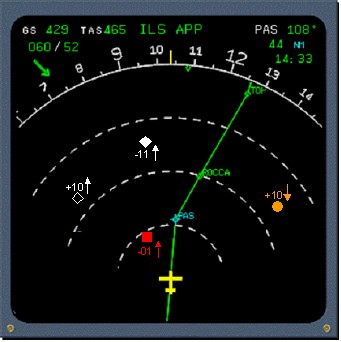
Every commercial airplane in the United States is required to have a Traffic Collision Avoidance System, or TCAS, unit installed onboard. While Air Traffic Control (ATC) maintains the responsibility to safely control airspace, pilots are also able to see nearby airplanes thanks to TCAS. The TCAS system is composed of three parts. First, there is a TCAS computer installed in the aircraft’s avionics network. Second, there are four antennas on the outside of the aircraft - two on the top, two on the bottom. Third, there are two displays in the flight deck. (“TCAS” wikipedia.org)

“The TCAS system builds a three dimensional map of aircraft in the airspace, incorporating their range (garnered from the interrogation and response round trip time), altitude (as reported by the interrogated aircraft), and bearing (by the directional antenna from the response). Then, by extrapolating current range and altitude difference to anticipated future values, it determines if a potential collision threat exists.” (“TCAS” wikipedia.org) Should the two flights come too close, the two TCAS systems will communicate with each other so that each aircraft is given the appropriate avoidance instructions (for example, one is told to descend while the other is told to climb).

So, who has the final say - ATC or TCAS? ATC is unaware of the direction that TCAS has instructed the pilot to move in order to avoid collision. For this reason, the pilots are required to listen to the instructions from TCAS versus ATC. Keep this important fact in mind as I reveal more information about how the Überlingen crash was able to happen.

TCAS Display (Source: wikipedia.org)

How did TCAS fail that fateful night?

The first factor in the crash was the failure of Swiss ATC to properly respond to the fact that both planes were flying at 36,000 feet on a collision course. That night, some of the ATC radar systems were working slower due to being upgraded and while two controllers were technically on duty, only one was awake. Peter Nielsen, the lone controller, was too preoccupied with another flight to properly address the imminent disaster. With only less than a minute before impact, Nielsen told the Tupolev to descend 1,000 feet to avoid the Boeing. Following Nielsen's orders, the Tupolev began to descend. He gave no instructions to the Boeing. (“2002 Überlingen mid-air collision” wikipedia.org)

Viewing this crash from a mechanical standpoint, TCAS did not fail; it was installed and working properly on both airplanes. The fatal problem occurred when TCAS gave its instructions after Nielsen did - it told the Boeing to descend and the Tupolev to climb, contradicting Nielsen's orders. Ignoring TCAS, the Tupolev continued descending. Following TCAS to some degree, the Boeing began to descend - however not as fast as TCAS had instructed. (“2002 Überlingen mid-air collision” wikipedia.org) The result was catastrophic.

Collision Aftermath

The mid-air collision shook the aviation safety community. As a result, TCAS and ATC systems were upgraded and improved. Pilots were given clearer instructions to always follow TCAS over ATC. Controller Peter Nielsen took time off work due to traumatic stress. In 2004, he was murdered by Vitaly Kaloyev, whose wife and children perished onboard the Tupolev.

To read more about TCAS, this and other air disasters, and other ways GIS has improved aviation safety, check out "Why Planes Crash and How Technology is Keeping us Safe" written by real airline pilot (versus me, the wannabe).